
CWDM Module Coarse Wavelength Division Multiplexing
Originally, the term coarse wavelength division multiplexing (CWDM) was fairly generic and described a number of different channel configurations. In general, the choice of channel spacings and frequency in these configurations precluded the use of erbium doped fiber amplifiers (EDFAs). Prior to the relatively recent ITU standardization of the term, one common definition for CWDM was two or more signals multiplexed onto a single fiber, with one signal in the 1550 nm band and the other in the 1310 nm band.

CWDM Applications
CWDM is being used in cable television networks, where different wavelengths are used for the downstream and upstream signals. In these systems, the wavelengths used are often widely separated. For example, the downstream signal might be at 1310 nm while the upstream signal is at 1550 nm.[citation needed]
Some GBIC and small form factor pluggable (SFP) transceivers utilize standardized CWDM wavelengths. As a classic synchronous digital transmission solution in optical fiber communications, SDH is often paired with CWDM technology to achieve efficient networking. GBIC and SFP CWDM optics allow a legacy switch system to be “converted” to enable wavelength multiplexed transport over a fiber by selecting compatible transceiver wavelengths for use with an inexpensive passive optical multiplexing device.
The 10GBASE-LX4 10 Gbit/s physical layer standard is an example of a CWDM system in which four wavelengths near 1310 nm, each carrying a 3.125 gigabit-per-second (Gbit/s) data stream, are used to carry 10 Gbit/s of aggregate data.
Passive CWDM is an implementation of CWDM that uses no electrical power. It separates the wavelengths using passive optical components such as bandpass filters and prisms. Many manufacturers are promoting
passive CWDM to deploy fiber to the home.
What Is DWDM Dense Wavelength Division Multiplexing?
Unlike CWDM, DWDM (Dense Wavelength Division Multiplexing) connections can be amplified and can, therefore, be used for transmitting data much longer distances.
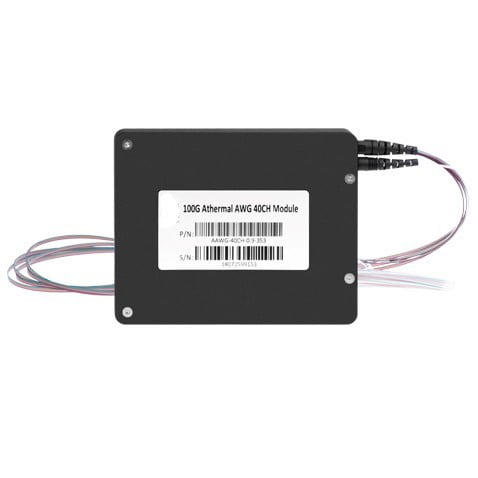
As the demand for Dark Fibre and capacity has increased, Dense Wavelength Division Multiplexing (DWDM) has been an important component. This involves multiplexing of multiple virtual fibres – that is, the splitting out the colours of the infrared spectrum using laser transmitters tuned to each colour wavelength – meaning more data can be sent via a single fibre at the same time thus increasing bandwidth.
CWDM supports up to 18 wavelength channels transmitted through a fiber at the same time. To achieve this, the different wavelengths of each channel are 20nm apart. DWDM, supports up to 80 simultaneous wavelength channels, with each of the channels only 0.8nm apart. CWDM technology offers a convenient and cost-efficient solution for shorter distances of up to 70 kilometers. For distances between 40 and 70 kilometers, CWDM tends to be limited to supporting eight channels.
