
MPO Patch Cords Patch Cable ,MefiberOptic.Com manufactures and distributes a wide range of /MPO products including Single-mode and Multimode MPO and MTP fiber cable. The MPO fiber cable connector offers up to 12 times the density of standard connectors, providing significant space and cost savings. High density MPO trunk cables can house up to 288 fibers in a single cable.
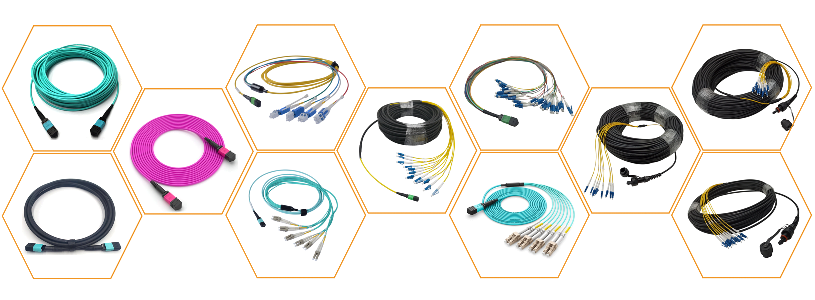
MPO Patch Cords Patch Cable Assemblies
MPO Patch Cords Patch Cable can be mass terminated in combinations of 4, 8, 12, 24 and 48 fiber ribbon cables and are typically used in high-density backplane and Printed Circuit Board (PCB) applications within data and telecommunications systems.
People use the terms MPO and MTP interchangeably and many customers have asked us to clarify the difference between the two. MPO is a fiber connector type while MTP is a registered trademark of an MPO connector manufactured by US Conec. All MTPs are MPOs but not all MPOs are MTPs. MPO stands for Multi-Fiber Push On.

MPO Patch Cords Patch Cable Assemblies
Multi-fiber push on connectors, or MPOs for short, are fiber connectors comprised of multiple optical fibers. While defined as an array connector having more than 2 fibers, MPO Connectors are typically available with 8, 12 or 24 fibers for common data center and LAN applications. MTP® is an acronym for Multi-fiber Termination Push-on and is the standardized terminating end of a multi-fiber cable that supports for all practical intents and purposes up to 24 fiber strands per connector.
MPO patch cord (Ribbon fan out Fiber patchcord, Ribbon mliti cable fan out) use MTP and MPO multi fiber type connectors, each one of the connector are used with ribbon type fiber optic cables which contain multi fiber in one single jacket, so that MPO Fiber Patch Cord greatly save space and are very convenient to use. Based on single ferrule MT technology, the MPO Fiber Patch Cord assemblies provide up to 72 fiber connections in a single point, reducing the physical space and labor requirement, while providing the same bandwidth capacity of a multi-fiber cable with individual fiber connector terminations per cable.
Typically with MT series like MTP fiber connectors and with multi fiber ribbon cables, these MPO Fiber Patch Cord features multi fiber connection in the same single core fiber optic patch cord.
● MT Patch Cords MT-MT MT-FA Patch Cable
● MPO Harness Cables
● MPO-LC Harness Breakout Cables
● MPO Trunk Harness Cables
● MPO Conversion Harness Cables
When upgrading data centers or building new fiber networks, MTP/MPO cable selection focuses on: fiber count, transmission mode (single-mode/multi-mode), and connector type.
Market products range from 4 to 72 fibers, with 12-fiber being the most common for 40G/100G Ethernet and small-to-medium data centers.
Choose between single-mode (OS2) for long distances (10km+) or multi-mode (OM3/OM4) for shorter distances (100-150 meters) within data centers.
MTP/MPO connectors offer high density and performance. MTP is a premium version of MPO with lower insertion loss and longer life.
Warranty
Typically 1-3 years (don't believe "lifetime warranty" claims)
Delivery
3-7 business days, custom orders 2-3 weeks
Returns
Standard products returnable within 7 days if original packaging maintained
Price Protection
30-day price protection: refund available if price drops
Understand the different classifications of MTP/MPO fiber cables to make the right choice for your network.
12-Fiber Configuration
Most Common
40G/100G Ethernet Small-to-medium DC
Price: $45-$120
Advantages: Best compatibility, affordable
Limitation: Only supports up to 100G; choose 24-fiber if planning for 400G
24-Fiber Configuration
High Density
100G/400G Networks Medium-to-large DC
Price: $85-$280
Advantages: High density, saves space
Note: Equipment must support 24-fiber interfaces
48/72-Fiber Configuration
Ultra-High Density
Large DC Backbone
Price: $180-$450
Note: Complex installation, professional team recommended
Multimode (OM3/OM4)
Distance
100-150 meters
Price
$50-$200
Scenario: Data center internal interconnection
Advantage: Transceivers cheap (1/3 of single-mode cost)
Single-mode (OS2)
Distance
10km+
Price
$65-$250
Scenario: Cross-building, campus networks
Disadvantage: Transceivers 2-3x more expensive
Type A
Most Common
Straight-through polarity where fiber 1 connects to fiber 1, fiber 2 to fiber 2, etc.
Best for: Breakout scenarios

Type B
Reversed
Reversed polarity where fiber 1 connects to fiber 12, fiber 2 to fiber 11, etc.
Best for: Switch-to-switch direct connection

Type C
Pair-flipped
Pair-flipped polarity where fiber pairs are flipped (1↔2, 3↔4, etc.).
Best for: Maximum compatibility
Note: 5-10% more expensive but less error-prone

Follow these steps to select the perfect MTP/MPO fiber cable for your specific needs.
Current 40G, upgrading to 100G within 3 years
Go straight to 12-fiber OM4 or OS2
Planning for 100G or 400G
Consider 24-fiber
Uncertain about future
Conservative recommendation: 12-fiber OM4
Avoid This Pitfall: Choosing OM3 to save $500, then discovering insufficient distance during upgrade, requiring complete re-cabling costing $5,000 more.
<100m (between cabinets)
OM3 sufficient, OM4 better
100-300m
OM4 optimal
>500m (cross-building)
Must use single-mode
Large campus with expansion
Single-mode backbone, multimode access
Common Mistake: Thinking single-mode is more "advanced" and using it everywhere, then discovering transceiver costs are 3x higher with actual distance only 50m.
Cabinets spacious
12-fiber sufficient
Cabinets already full
24-fiber or higher density saves 30% space
New data center
Plan based on 5-year port growth
ROI Tip: High-density configurations cost 20-30% more initially, but can delay cabinet expansion by 1-2 years with high ROI.
Standardized switches
Type B most straightforward
Need breakout
Type A standard
Team unfamiliar with polarity
Recommend Type C, slightly more expensive but less error-prone
Cable cost is only 20-30% of total cost; transceivers, labor, and downtime losses are the major expenses.
| Cost Component | Considerations |
|---|---|
| Cable cost | Baseline |
| Transceivers | Multimode 2-3x cheaper |
| Installation labor | High-density 20-30% more |
| Future expansion | Adequate reserves save second cabling costs |
| Downtime loss | 1-hour downtime in production may exceed entire material cost |
Answer a few questions to find the right MTP/MPO cable for your needs
1. What is your current and future bandwidth requirement?
Current 40G, no plans for 100G
Current 40G, upgrading to 100G within 3 years
Planning for 100G or 400G now
2. What is the maximum transmission distance?
<100m (between cabinets)
100-300m
>500m (cross-building or campus)
3. What is your cabinet density situation?
Cabinets are spacious
Cabinets are filling up
Cabinets are already full
4. What type of polarity management do you need?
Need breakout cables (Type A)
Standard switch-to-switch (Type B)
Maximum compatibility (Type C)

Find the right configuration based on your organization's size and specific needs.
Small Enterprise
50-100 ports
Solution:
12-fiber OM3 + Type B polarity
Budget:
$3,500-$6,000
Rationale:
Best cost-performance, completely sufficient within 100m
Tip: If upgrading to 100G within 3 years, spend 15% more for OM4
Medium Data Center
200-500 ports
Solution:
Core 24-fiber OM4 + Access 12-fiber OM4
Budget:
$25,000-$45,000
Rationale:
High density saves space, supports future 400G upgrade
Large Data Center
500+ ports
Solution:
Backbone 48/72-fiber OM4/single-mode + 24-fiber branches
Budget:
$150,000+ (custom solution)
Note:
Professional installation team and documentation management required
Cross-Building
Long Distance
Solution:
12/24-fiber OS2 single-mode + outdoor-grade armored
Budget:
$8,000-$20,000
Rationale:
Only single-mode supports >500m
Solution: 24-fiber OM4 trunk + 12-fiber OM4 access

Solution: 12-fiber MPO-to-4xLC breakout
Advantage: 60% reduction in installation time

Solution: 12-fiber OS2 single-mode + outdoor-grade armored
Building B
Phase 1:
Install MPO patch panels, temporarily use breakout to interface with LC equipment
Phase 2:
Core switch upgrade, activate MPO direct connection
Phase 3:
Gradually replace edge equipment
Cost: 15% more in materials but 80% less downtime
Understand the technical specifications that make MTP/MPO fiber cables the ideal choice for high-density networks,Further knowledge on fiber optic cable technology.
12 or 24 fibers precisely arranged in ceramic ferrule, 250-micron spacing, ±1-micron tolerance. This is key to MTP achieving high density.

| Type | Core | Distance @ 100G | Price | Transceiver Cost |
|---|---|---|---|---|
| OM3 | 50μm | 100m | Baseline | Low |
| OM4 | 50μm | 150m | +15% | Low |
| OS2 | 9μm | 10km+ | +20% | 2-3x higher |
Type A
1-to-1 straight-through
Type B
1-to-12 reversed
Type C
Pair-flipped
Important: Wrong polarity = no transmission, but will show connection, making troubleshooting painful.
Each connection point has 0.35-0.75dB insertion loss; total link loss must stay within allowable range. High-density configurations must be tested.
Typical Loss Budget Calculation
Transmitter Power 0 dBm
Receiver Sensitivity -10 dBm
Cable Loss (100m OM4) -1.5 dB
Connector Loss (4 connections) -1.4 dB
Margin -7.1 dB
| Quantity | Discount | Additional Services |
|---|---|---|
| 50-99 | 8-10% | Free test reports |
| 100-199 | 12-15% | Testing + on-site guidance |
| 200-499 | 15-20% | Testing + training + 1-year extended warranty |
| 500+ | Custom quote | Complete solution design + implementation support |
Transceivers
Often 3-5x cable cost. Single-mode transceivers are significantly more expensive than multimode.
Cable Tray Modifications
May be needed for high-density configurations. Existing infrastructure may not support the higher density.
Compatibility Testing
Best to test different manufacturers yourself. Mixing components can lead to performance issues.
Recommendation: Purchase small quantities first for testing before committing to large orders.
Learn about our comprehensive service and support offerings.
Standard: 1 year (standard products) / 3 years (premium)
Coverage: Manufacturing defects, excessive insertion loss, physical damage (non-human)
Not covered: Human damage, use beyond specifications
Standard: 3-5 business days (in stock), custom 15-20 days
Free shipping: Orders over $500
Rush service: Add 30-50% rush fee
Return period: Within 7 days of receipt, unopened
Return conditions: Intact packaging, no installation marks
Non-returnable: Custom products (non-quality issues), already installed and tested
Hours: Business days 9:00-18:00
Response: Within 4 hours (business days)
Channels: Phone, email, online
